


Why on-chain options keep dying
Perpetual futures took over crypto trading; on-chain options have died several times over. The reason is structural: an option is not one product but a grid of strikes, expiries, sides and sizes, and pooled designs split that grid into thin markets and sell to better-informed traders. What the numbers show, where options actually trade, and the request-for-quote design I am building instead.
This week I kept getting the same question, from investors, from other builders and at dinner on Thursday: why options? Crypto has lending, perpetual futures and now prediction markets that work on-chain. Options have been tried again and again, and every generation has faded. Some of my own money is still sitting in one of them, Katana, a Solana options vault I first used in 2022.
My answer is that the failures are not bad luck or bad teams. They come from the structure of the product. Perpetual futures found a structure that fits a blockchain. Options, as they have been built on-chain so far, have not.
Perpetuals found a structure
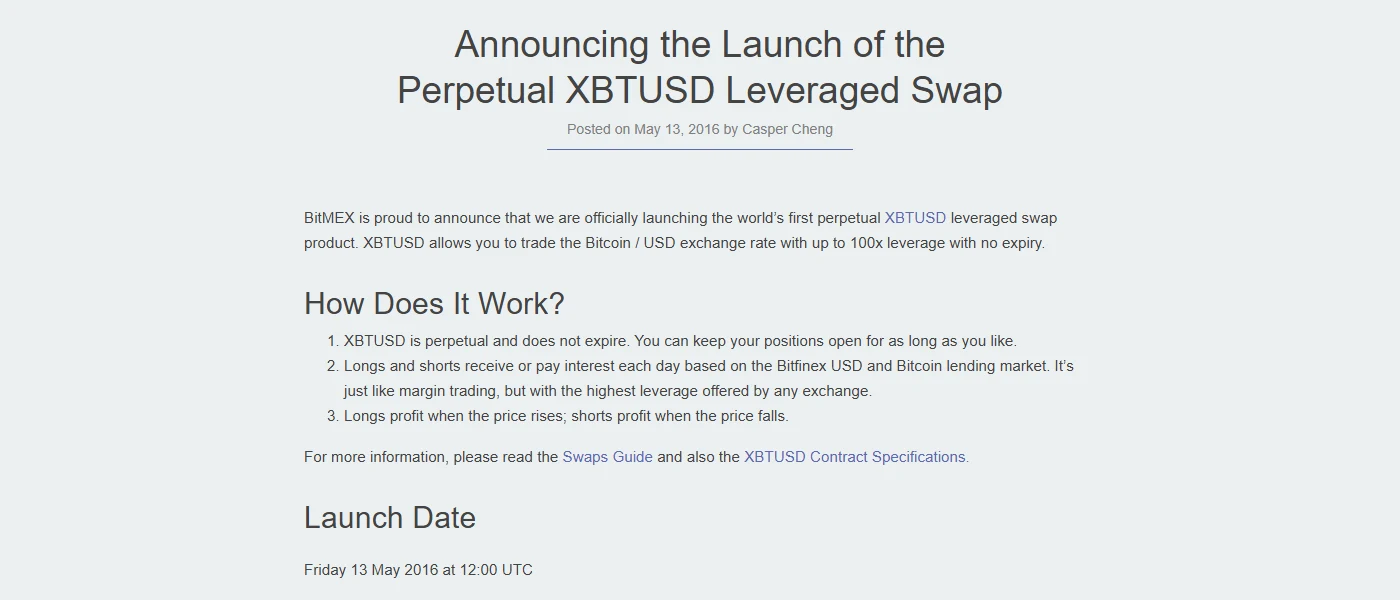
On 13 May 2016, BitMEX launched the first perpetual swap, XBTUSD: a Bitcoin/USD contract with up to 100x leverage and no expiry, kept close to the spot price by a periodic funding payment between longs and shorts [1]. Almost every major exchange now runs a copy of it.
The perpetual succeeded because of its shape. It is one instrument per asset, with no expiry to roll, so every buyer and seller in the world meets in the same order book. Its payoff is linear, so a market maker can hedge it with spot at any moment. And leverage is built in. That shape moved on-chain without much change: centralised exchanges traded $86.2 trillion of perpetuals in 2025, and decentralised ones, led by Hyperliquid, another $6.7 trillion [2].
Options are a different story. Deribit, which handles most of the world’s crypto options, traded $743 billion of them in 2024 [3]. The same year, centralised exchanges traded around $58 trillion of perpetuals, which follows from CoinGecko’s 2025 figure and its 47.4% growth rate [2]. Crypto options are one or two percent of perpetual volume, and almost none of that is on-chain.
An option is not one product
A perpetual on SOL is one contract. An option on SOL is a choice along four axes: the strike price K, the expiry T, calls or puts, and the size q. A buyer’s request is a point in that space:
An exchange that lists options has to choose which points to open markets for, and the count multiplies:
Deribit lists close to a thousand BTC options at any one time, across about a dozen expiries, where the same exchange has two BTC perpetuals. Every one of those contracts needs its own buyers and sellers.
Deribit can live with this because it is a single order book run by professional market makers who quote the whole grid at once from one model of volatility and hedge the net result. On-chain options protocols usually cannot. Each strike and expiry becomes its own pool or vault, the liquidity is cut into hundreds of pieces, and each piece is thin. The size axis is not even on the grid: a pool quotes the same terms to a trader buying one contract and to one buying five hundred.
Pools sell to the people who know more
The second problem is who the pools end up trading with. An automated pool quotes an option from a formula and an oracle: a price for the underlying and an estimate of volatility, updated slowly. The trader on the other side chooses when to trade. When the trader knows something the formula does not, such as that volatility is about to rise or the oracle is stale, the trade happens. When the pool’s price is too generous in the other direction, it does not. Over time the pool’s liquidity providers are left holding the trades that informed traders wanted to make. That is adverse selection, and it is the same mechanism that makes an ordinary AMM’s liquidity providers lose to arbitrageurs, which I worked through for impermanent loss in 2022.
Option vaults, the generation after the pools, took the other side of the same problem. A vault such as Katana or Ribbon sells options on its depositors’ assets every week, usually at auction to market makers [4], [5]. The vault is always the seller, on a fixed schedule, at a strike chosen by a rule, and the buyers are professionals who decide what the options are worth. In a quiet market the depositors collect a premium. In a sharp rally they give up the upside, and nothing in the design lets them choose not to sell.
The results are on DefiLlama. Every protocol in the chart below was, at its peak, one of the leading on-chain options protocols. None of them is still a real market.
This week the list above is a combined $18 million. At their peaks, Ribbon, Lyra, Hegic and Katana alone held almost $600 million. Opyn’s peak overlaps with Ribbon’s: Ribbon’s vaults locked their collateral in Opyn’s contracts [5], so much of the same money appears in both bars.
Where options actually trade
Demand for options payoffs is not the problem. It is simply met in other ways.
First, most derivatives in traditional finance are not traded on a screen at all. They are negotiated over the counter, one counterparty at a time: $846 trillion notional outstanding at the end of June 2025, according to the Bank for International Settlements [7]. A bank’s client asks for a price on the exact strike, expiry and size it wants, several dealers quote, and the client picks one.
Second, the crypto exchanges sell options without calling them options. Binance’s Dual Investment lets a user earn a yield by agreeing to sell their crypto at a higher target price, or buy at a lower one, on a set date [8]. The first is a covered call and the second a cash-secured put. The exchange hides the grid behind a single yield number.
Third, the largest asset managers are packaging the same trade for their own clients. On 14 April, Goldman Sachs filed for a Bitcoin Premium Income ETF, which takes its Bitcoin exposure through spot Bitcoin exchange-traded products and writes call options on them for income [9].
What these have in common is that none of them pools liquidity across the grid. Either someone quotes each request individually, or someone picks one point on the grid and packages it as a product.
What I’m building instead
That is the idea behind Anneal, the protocol my team is building for Colosseum’s Frontier hackathon: an options market on Solana that works like an over-the-counter desk rather than an exchange. A buyer describes the option they want, the full request (K, T, side, q), and several writers compete to quote it. A zero-knowledge proof lets the buyer keep their maximum budget private, so writers compete on price rather than on what they can infer. Settlement is in USDC, in cash, so neither side needs to deliver the underlying.
The design choices follow from the two problems above. It is one buyer to many writers, not many to many, because a writer who shows up to quote is liquidity; the protocol does not need to aggregate a pool. Every quote is backed by a bond, because an over-the-counter market works only if a winning writer cannot walk away. And because the quotes come from software agents, each quote is checked against the Black–Scholes price for that request:
Evaluated over a range of volatilities σ, it gives a band that an agent’s quote has to fall inside. The formula does not set the price; the competing writers do. It only stops an agent from quoting something absurd in either direction.
What could still kill it
I have heard the objections this week too, and they are fair. Privacy matters little to retail traders, whose orders are too small to move a market, so they are unlikely to pay extra for it. A bespoke option cannot be closed early, because there is no secondary market for that exact contract. Small tickets may not be worth a professional writer’s time. And the hardest question for any two-sided market remains: who writes? The best answers I have are Solana validators, who hold staked SOL and may want to earn a premium on it; market makers connected by API; and treasuries that want short-dated protection on the tokens they hold.
None of this is solved by a hackathon. But the history above convinces me that the answer is not a better pool. Perpetuals won because their structure fits a single shared market. Options do not fit one, and the on-chain designs that treated them as if they did have died. If options are going to work on-chain, I think they will look like the way options already trade everywhere else: a request, competing quotes, and a contract the two sides agree on.
References
- Casper Cheng. Announcing the launch of the perpetual XBTUSD leveraged swap. BitMEX blog, 13 May 2016. Archived copy: 13 May 2016.
- CoinGecko. 2025 annual crypto industry report. 15 January 2026. coingecko.com.
- Deribit. Deribit reports Q4 and 2024 year-end volumes; provides operational update. 22 January 2025. insights.deribit.com.
- Sitesh Kumar Sahoo. How to Katana: the yield machine on Solana, a deep dive. Medium, 24 March 2022. insitesh.medium.com.
- Ribbon Finance. Theta vaults architecture. Ribbon documentation. docs.ribbon.finance. Archived copy: 15 February 2026.
- DefiLlama. Historical total value locked for Opyn Gamma, Ribbon, Lyra v1, Hegic and Katana.
- Bank for International Settlements. OTC derivatives statistics at end-June 2025. 8 December 2025. bis.org.
- Binance Academy. What is Binance Dual Investment? Updated 21 August 2025. binance.com.
- Goldman Sachs ETF Trust. Goldman Sachs Bitcoin Premium Income ETF, preliminary prospectus (Form 485APOS). U.S. Securities and Exchange Commission, filed 14 April 2026. sec.gov.