


What a transmon actually is
Most pictures of a qubit show a glowing particle. The qubits inside Google's and IBM's machines are circuits you can see under an ordinary microscope. How a capacitor and one strange junction make an artificial atom, why it has to be big and boring, and why it needs a fridge colder than space.
Last month the Nobel Prize in Physics went to three people who showed that an electrical circuit can behave like a single quantum particle [1]. Yet when a news story needs a picture of a qubit, it still reaches for a glowing sphere, and the first question I get when I say I work on superconducting qubits is usually “how small is it?”. The honest answer is: not small at all. The transmon, the qubit inside most of today’s superconducting quantum computers, is a patch of aluminium on a chip, a fraction of a millimetre across. It is not an atom. It is a circuit pretending to be one. In this post I want to show how that pretence works, using as little maths as possible but no less: a swing, a pendulum, and one strange junction.
A swing made of electricity
Start with the simplest circuit that can oscillate: a capacitor and an inductor in a loop. Energy sloshes from the capacitor into the inductor and back, the way a child on a swing trades height for speed. Writing the charge on the capacitor as Q and the magnetic flux in the inductor as Φ, its energy is [2]
which is exactly the energy of a mass on a spring, with the capacitance playing the mass. Cool the circuit until it is superconducting, so that nothing is lost to resistance, and quantum mechanics takes over: Q and Φ become operators that cannot both be sharp, just like position and momentum, and the energy can only take the values
So far, so quantum. But this is a useless qubit. A qubit needs two levels you can move between without disturbing anything else, and here every rung of the ladder is exactly the same height. A microwave pulse tuned to lift the circuit from the bottom rung to the next will lift it from the next to the one above just as happily, and the state climbs up the ladder like a swing that keeps getting pushed. To make a qubit, the ladder has to be uneven.
The one strange element
The fix is a Josephson junction: two pieces of superconductor separated by an insulating layer only a nanometre or two thick. Cooper pairs, the bound electron pairs that carry a supercurrent, tunnel straight through it, and the current that flows depends not on a voltage but on the difference φ between the quantum phases on its two sides [3]:
A sine is not a straight line, so the junction behaves as an inductor whose inductance changes with the current through it. It is nonlinear and it dissipates no energy, and that combination is why it sits at the heart of every superconducting qubit [2]. Put a junction in place of the inductor, and the energy becomes [2] [4]
where n counts the Cooper pairs that have crossed the junction, EC is the energy it costs to charge the circuit’s total capacitance CΣ by one electron, and EJ is the energy stored in the junction. (The odd factor of 4 is a historical leftover: EC was defined for single electrons before anyone was counting pairs.)
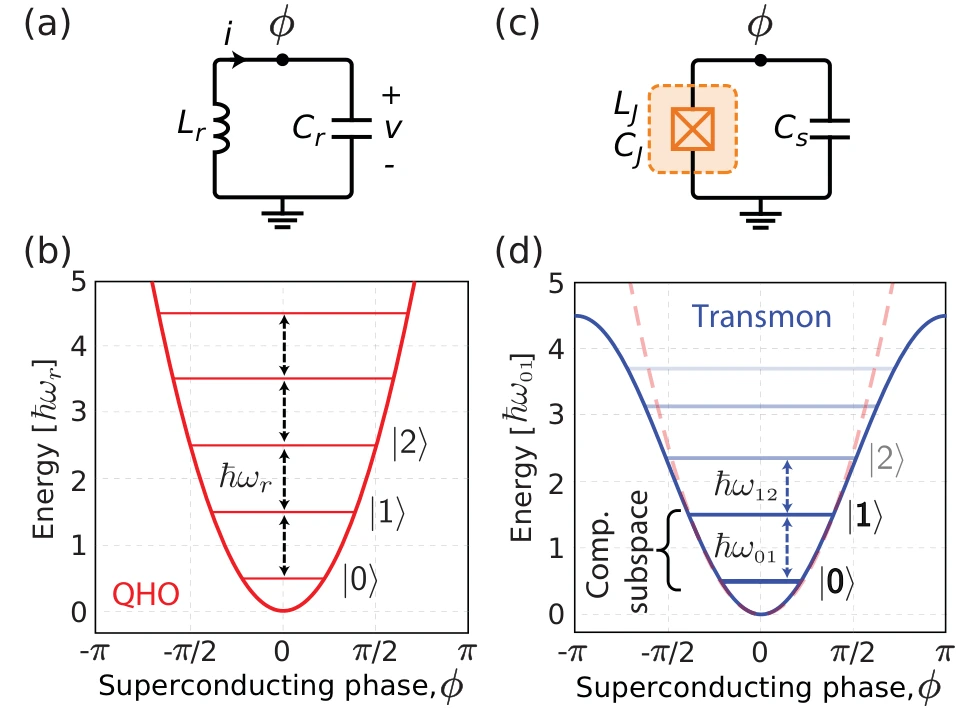
If this formula looks familiar, it should. It is the energy of a pendulum: n plays the angular momentum, φ the angle of the bob, and −EJ cos φ the height of the bob in gravity. An LC circuit is a swing that obeys Hooke’s law however far it goes. A transmon is a real pendulum, and real pendulums are not perfect clocks.
Why the steps shrink
Expand the cosine for small swings, and the pendulum turns back into a swing with a correction:
The φ2 term on its own gives back the even ladder. The φ4 term is what a grandfather clock knows: a pendulum swung wider ticks slightly slower, because the restoring force grows more slowly than the angle. For the quantum pendulum this means each rung sits a little lower than the even ladder would put it, and the higher you go, the more it sags. To a good approximation the two lowest levels are separated by [2]
The first term is the plasma frequency of the junction, the same quantity that appeared in the 1985 experiment that won the Nobel [1]. The second is the anharmonicity α: how much shorter the second step is than the first. In real devices the qubit frequency ω01/2π is designed to sit between about 3 and 6 GHz, and the anharmonicity is only 100 to 300 MHz, a few percent [2]. That is enough. A microwave pulse at ω01 now moves the state between the bottom two rungs and is slightly out of tune for everything above. The bottom two rungs are the qubit: compare panels (b) and (d) of the figure above.
Why make it big and boring
The transmon was not the first qubit made this way. In 1999, Nakamura, Pashkin and Tsai showed coherent oscillations in a “Cooper-pair box”, a tiny superconducting island with a small capacitance and so a large EC [5]. It was a landmark, but its oscillations lasted only a few nanoseconds, and the box had a deeper problem: charge. With a small capacitor, the qubit’s frequency depended on the exact number of stray electrons near the island, and those move around constantly.
The transmon, proposed in 2007, solved this by doing something that sounds like a step backwards: it put a large capacitor across the junction, making EC small and the ratio EJ/EC large, typically 50 or more [4] [2]. (The name is short for “transmission-line shunted plasma oscillation qubit” [4].) The trade looks bad at first sight, because the anharmonicity is EC, so shrinking EC makes the ladder more even again. The trick is in how fast each effect falls. The sensitivity to stray charge drops exponentially as EJ/EC grows, while the anharmonicity drops only slowly, as a power of the ratio [4]. Somewhere around EJ/EC ≈ 50 the charge noise has all but vanished and there is still enough anharmonicity to address the qubit. The price is speed: with only a few percent of anharmonicity, pulses cannot be made too short or they start to leak into the third level, which is why control engineers shape them carefully, for example with DRAG pulses [2].
This is why a transmon is big. Most of the chip area is the shunt capacitor, a pair of metal pads large enough to see under an ordinary optical microscope, while the junction itself is tiny. Google’s Sycamore processor, which ran the 2019 “quantum supremacy” experiment, was a grid of 53 working transmons [6].
Colder than space
One question remains: why the dilution refrigerator? A qubit at frequency ω01 stays in its ground state only if the surroundings are too cold to kick it up by accident. The chance of finding it thermally excited is roughly
For a 5 GHz qubit, ħω01/kB is about 0.24 kelvin. Space, at 2.7 kelvin, would be far too hot. At 20 millikelvin, the chance is about six parts in a million; at 10 millikelvin, a few parts in a hundred billion. That is why the chip sits at the bottom of a dilution refrigerator at around ten millikelvin, and why the aluminium has to be superconducting in the first place: any resistance would turn the swing’s energy into heat and the qubit into noise.
In short
A transmon is an artificial atom. A real atom’s energy levels are fixed by nature, identical for every atom of the same element. A transmon’s levels are chosen by an engineer, through the size of a capacitor and the thickness of an oxide layer. That is its great advantage, since it can be designed, fabricated with the tools of the chip industry, and coupled to its neighbours with wires. It is also its burden: no two transmons on a chip are quite the same, and each one has to be measured and calibrated, which is where much of my PhD will go.
What still delights me is how little it takes. A capacitor, a junction a couple of nanometres thick, and a fridge, and billions of electrons agree to behave as one pendulum with exactly two levels that matter. In 1978 Anthony Leggett asked whether a macroscopic variable could obey quantum mechanics at all [1]. Today we fabricate them by the hundred.
References
- The Royal Swedish Academy of Sciences. The Nobel Prize in Physics 2025, press release and scientific background, 7 October 2025. Press release; scientific background. See also my post The week superconducting qubits won the Nobel.
- P. Krantz, M. Kjaergaard, F. Yan, T. P. Orlando, S. Gustavsson and W. D. Oliver. A quantum engineer's guide to superconducting qubits. Applied Physics Reviews 6, 021318 (2019), section II.A. doi:10.1063/1.5089550; arXiv:1904.06560.
- B. D. Josephson. Possible new effects in superconductive tunnelling. Physics Letters 1, 251 (1962). doi:10.1016/0031-9163(62)91369-0.
- J. Koch, T. M. Yu, J. Gambetta, A. A. Houck, D. I. Schuster, J. Majer, A. Blais, M. H. Devoret, S. M. Girvin and R. J. Schoelkopf. Charge-insensitive qubit design derived from the Cooper pair box. Physical Review A 76, 042319 (2007). doi:10.1103/PhysRevA.76.042319.
- Y. Nakamura, Yu. A. Pashkin and J. S. Tsai. Coherent control of macroscopic quantum states in a single-Cooper-pair box. Nature 398, 786 (1999). doi:10.1038/19718.
- F. Arute et al. Quantum supremacy using a programmable superconducting processor. Nature 574, 505 (2019). doi:10.1038/s41586-019-1666-5.