


The week superconducting qubits won the Nobel
Two months into a PhD on superconducting qubits, I watched the 2025 Nobel Prize in Physics go to the experiment my whole field stands on. What Clarke, Devoret and Martinis showed in 1985, the equations behind it, and how it leads to the qubits my group works on.
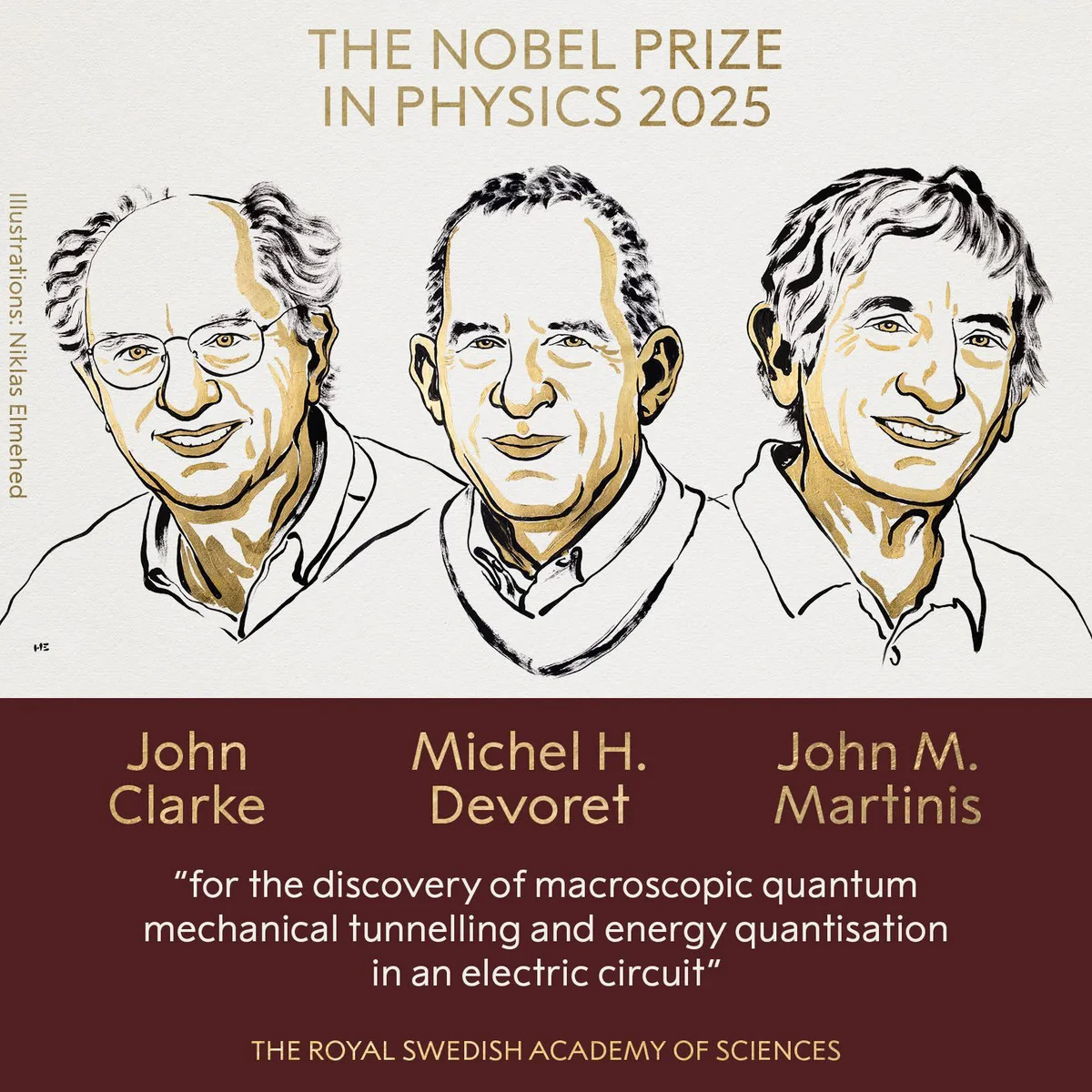
Yesterday evening, Singapore time, the Royal Swedish Academy of Sciences announced the Nobel Prize in Physics, and my whole group lit up. The prize went to John Clarke, Michel Devoret and John Martinis, “for the discovery of macroscopic quantum mechanical tunnelling and energy quantisation in an electric circuit” [1]. In plain words: they showed that an electrical circuit, something big enough to see and hold, can behave like a single quantum particle. Every superconducting qubit, including the ones my group measures, is built on that result. (The portraits at the top are by Niklas Elmehed, © Nobel Prize Outreach.)
I am two months into a PhD in a superconducting-qubit group. In August I had to choose between three directions: fabricating the chips, designing the circuits, or working on how qubits are controlled and read out. I chose control. Yesterday felt like being told, very publicly, that I had picked the right field.
A circuit that tunnels
The experiments were done at Berkeley in 1984 and 1985. They used a Josephson junction: two pieces of superconductor separated by an insulating barrier a few nanometres thick. In a superconductor, electrons pair up into Cooper pairs, and all the pairs share a single quantum phase. The junction is described by one variable, the difference between the phases on its two sides, φ, and by two equations due to Josephson:
A supercurrent up to a critical value Ic flows with no voltage at all. If you push a current I through the junction, the phase behaves like a particle rolling on a tilted washboard:
The capacitance of the junction plays the part of the particle’s mass. As long as the “particle” sits in one of the wells, the phase is constant and there is no voltage. If it escapes over the barrier, it runs down the washboard, and a voltage suddenly appears across the junction. That jump is easy to detect, and timing it many thousands of times gives an escape rate.
The question was how the particle escapes. At higher temperatures it is kicked over the barrier by thermal noise, and the escape rate falls as the circuit is cooled. Quantum mechanics predicts that below a certain temperature the rate should stop falling, because the phase no longer needs to climb over the barrier: it can tunnel through it. The crossover comes where thermal energy becomes comparable with the energy of small oscillations at the bottom of a well [2]:
Here C is the junction’s capacitance and ωp is called the plasma frequency. For their junction, 10 micrometres across with a capacitance of about 6 picofarads, ωp/2π was around 4 GHz and the predicted crossover about 30 millikelvin [2]. The hard part was making a circuit quiet enough for this to be visible: the bias and voltage lines passed through filters packed with copper powder, so that stray microwave noise could not kick the particle over the barrier [2].
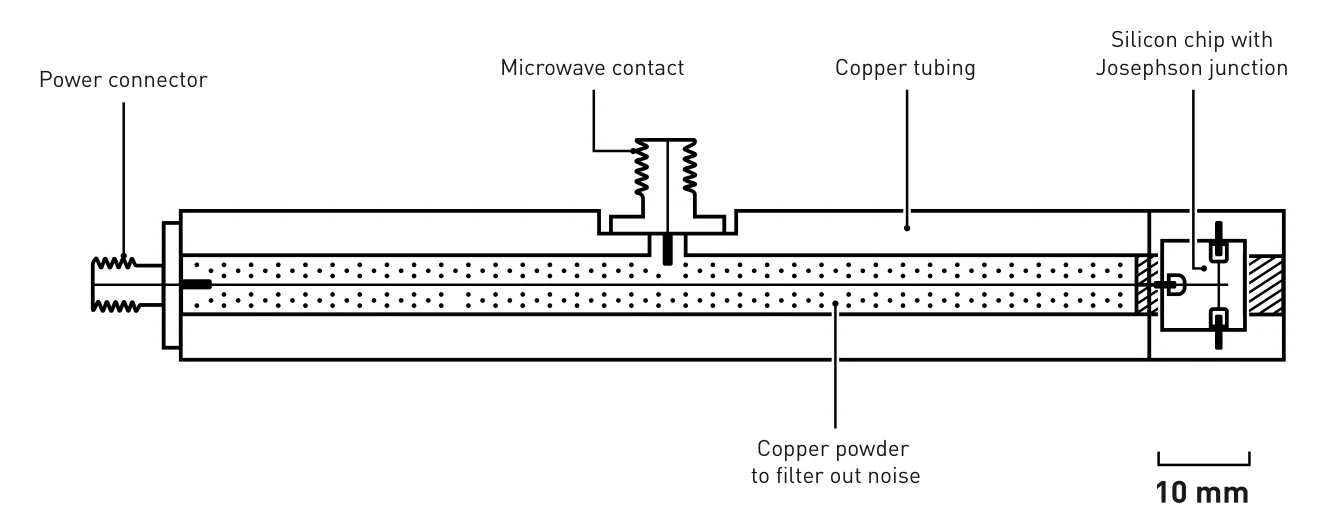
When they cooled the junction to below 20 mK, the escape rate flattened out where theory said it should, with no adjustable parameters [4]. Then they shone microwaves on it, and found that escape was enhanced only at particular frequencies. The energy in the well came in discrete levels, like the levels of an atom; an excited level sits higher up the barrier, so it tunnels out faster, and that is how the levels were seen [5]. That paper, “the first observation of quantized energy levels for a macroscopic variable”, was published on 7 October 1985. The prize was announced forty years later to the day.
What tunnelled, and what had quantised energy, was not an electron. It was the collective state of a circuit, with something like ten billion Cooper pairs acting as one degree of freedom [2].
The part I keep thinking about is who did it. Martinis was a graduate student in Clarke’s group and Devoret a postdoc, and the work became Martinis’s PhD thesis, written in 1985 [2]. A thesis experiment on a single junction became, forty years later, the foundation of an industry. Martinis went on to become Google’s chief scientist for quantum hardware, and in 2019 his team’s Sycamore processor ran the “quantum supremacy” experiment [6] [7].
From the washboard to a qubit
The qubits my group works on are transmons, a descendant of that junction. The difference is that the junction is no longer driven by a current. It is shunted by a large capacitor and sits isolated in a dilution refrigerator at around ten millikelvin. Its Hamiltonian is [8]
where n counts the Cooper pairs that have crossed the junction. It is the same cosine well, without the tilt. Because a cosine is not a perfect parabola, the levels are not evenly spaced, and that is what makes it a qubit: the lowest two levels can be driven with a microwave pulse at their own frequency without disturbing the next level up. When EJ is much larger than EC,
and √(8EJEC)/ħ is exactly the plasma frequency of the 1985 junction at zero current [8]. The qubit frequency is that same oscillation, corrected by the charging energy, and it lands at a few gigahertz, in the microwave band. One of the authors of the transmon paper, in 2007, was Devoret. Driving that transition with shaped microwave pulses is what qubit control means, and it is what I will spend the next few years on. In a sense it is the 1985 spectroscopy done on purpose, millions of times.
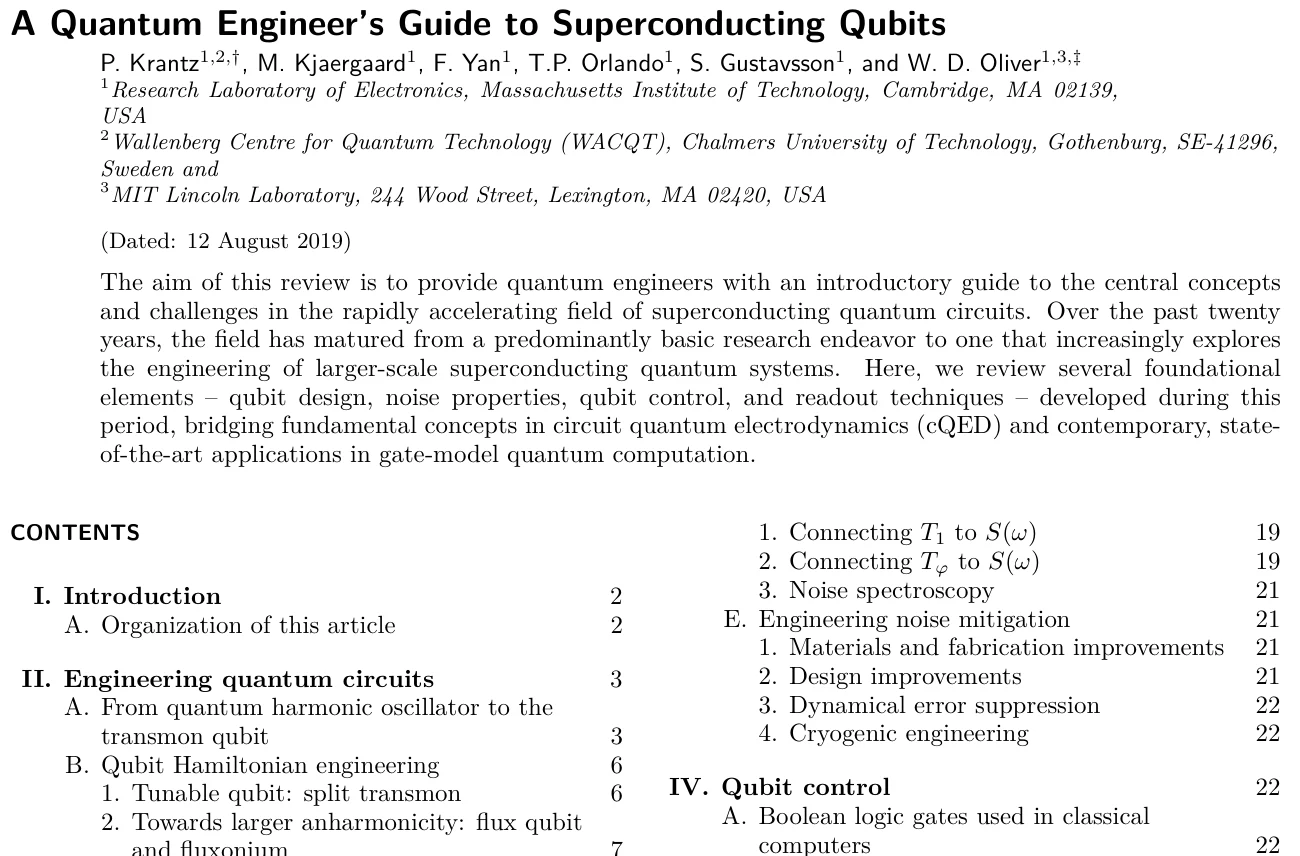
The review I have been working through since September, Krantz and colleagues’ A Quantum Engineer’s Guide to Superconducting Qubits, is built the same way [9]. Its first technical section goes “from quantum harmonic oscillator to the transmon qubit”, the Hamiltonian above is where it arrives, and a whole chapter is on qubit control: single-qubit gates driven by microwave pulses, the virtual Z gate, the DRAG pulse shape that keeps a drive from leaking into the third level. It is the closest thing my field has to a textbook for engineers, and it starts where the 1985 papers left off.
Natural atoms and artificial ones
An earlier physics prize for controlling single quantum systems went to David Wineland and Serge Haroche in 2012, “for ground-breaking experimental methods that enable measuring and manipulation of individual quantum systems” [10]. Wineland’s systems were trapped ions, and my final-year project was a laser system for trapped ions, so I have now worked on both sides.
An ion is a natural atom. Every ion of a species is identical, and nature fixes its levels. A transmon is an artificial atom: we choose its levels by choosing a capacitance and a junction. That means every qubit on a chip is slightly different and has to be calibrated, which is a large part of what control work is. It also means the chip can be designed and made with the tools of the semiconductor industry, and its gates run in nanoseconds rather than microseconds. That trade is why Google, IBM and many others build superconducting processors.
What it meant to us
Yesterday, a lot of people in my group said some version of the same thing. Two months into a PhD you mostly feel how much you don’t know. I spent yesterday morning in an exam for a graduate quantum information course, after very little sleep, and I still can’t derive the transmon Hamiltonian from the circuit as cleanly as I’d like. It helps to be reminded that the whole field started with one junction, a copper tube of filters, and a graduate student who measured very carefully. My future wasn’t the wrong pick.
References
- The Royal Swedish Academy of Sciences. The Nobel Prize in Physics 2025, press release, 7 October 2025. nobelprize.org.
- John M. Martinis. Macroscopic quantum tunneling and energy-level quantization in the zero voltage state of the current-biased Josephson junction. PhD thesis, University of California, Berkeley; Lawrence Berkeley Laboratory report LBL-20803, December 1985. escholarship.org.
- The Royal Swedish Academy of Sciences. Quantum properties on a human scale. Popular science background to the Nobel Prize in Physics 2025. nobelprize.org.
- Michel H. Devoret, John M. Martinis and John Clarke. Measurements of macroscopic quantum tunneling out of the zero-voltage state of a current-biased Josephson junction. Physical Review Letters 55, 1908 (1985). doi:10.1103/PhysRevLett.55.1908.
- John M. Martinis, Michel H. Devoret and John Clarke. Energy-level quantization in the zero-voltage state of a current-biased Josephson junction. Physical Review Letters 55, 1543 (1985). doi:10.1103/PhysRevLett.55.1543.
- John Martinis and Sergio Boixo. Quantum supremacy using a programmable superconducting processor. Google AI blog, 23 October 2019. research.google.
- Frank Arute et al. Quantum supremacy using a programmable superconducting processor. Nature 574, 505–510 (2019). doi:10.1038/s41586-019-1666-5.
- Jens Koch, Terri M. Yu, Jay Gambetta, A. A. Houck, D. I. Schuster, J. Majer, Alexandre Blais, M. H. Devoret, S. M. Girvin and R. J. Schoelkopf. Charge-insensitive qubit design derived from the Cooper pair box. Physical Review A 76, 042319 (2007). doi:10.1103/PhysRevA.76.042319.
- P. Krantz, M. Kjaergaard, F. Yan, T. P. Orlando, S. Gustavsson and W. D. Oliver. A quantum engineer's guide to superconducting qubits. Applied Physics Reviews 6, 021318 (2019). doi:10.1063/1.5089550; arXiv:1904.06560.
- The Royal Swedish Academy of Sciences. The Nobel Prize in Physics 2012, press release, 9 October 2012. nobelprize.org.