


How you calibrate a qubit
A caesium atom comes with its frequency fixed by nature. A transmon's frequency is whatever the cleanroom produced, and it drifts. Four experiments, invented for atoms and nuclei long before anyone built an artificial atom, turn a patch of aluminium into something you can program: Rabi, T1, Ramsey and echo. What each one measures, what the fits mean, and why the job is never finished.
The second is defined by an atom. It is 9 192 631 770 oscillations of one particular transition in caesium-133, and every caesium atom in the universe has exactly that frequency, which is why we trust it to run the clocks [1]. A transmon has no such guarantee. Its frequency is whatever the thickness of an oxide layer and the size of a capacitor made it, and it is not quite the same as it was yesterday. In an earlier post I wrote that each transmon on a chip has to be measured and calibrated before it can be used. This post is what that means: finding a qubit, pushing it, and timing how long it remembers. It takes four experiments, all invented for atoms and nuclei decades before anyone built an artificial atom, and I will follow the same guide as there [2].
Where is it?
A chip comes back from the cleanroom with design frequencies, not actual ones. The qubit frequency depends on the Josephson junction, an oxide barrier a nanometre or two thick, and no process reproduces that exactly. IBM found that on a lattice of fixed-frequency transmons, without trimming the junctions after fabrication, the chance of a chip on which no qubits collide in frequency is close to zero, so they now move each junction into place with a laser [3].
So the first measurement is a search. Each transmon sits next to its own readout resonator, whose frequency shifts slightly with the state of the qubit [2]. Sweep a probe tone to find the resonator, park on it, and sweep a second tone across the band where the qubit should be until the resonator flinches. That is the qubit, located to within a linewidth.
How hard to push
To rotate a qubit you push on it with a microwave pulse at its own frequency, fed in through a small capacitor. In the frame rotating with the qubit, a pulse in phase with the qubit’s oscillation rotates the state about the x axis of the Bloch sphere, and a pulse a quarter-cycle out of phase rotates it about y [2]. The angle of the rotation is set by the area of the pulse,
where s(t) is the shape of the pulse, V0 its amplitude, and Ω a constant fixed by the capacitors. Start in 0, apply a pulse of angle Θ, and the probability of finding the qubit in 1 afterwards is
This is a child on a swing again. Push in time with the swing and it goes higher; keep pushing and it comes over the top and down the other side. A pulse that takes the qubit exactly from 0 to 1 is a π pulse, half of that is a π/2 pulse, and every gate that follows is built from these two.
Keep the pulse shape fixed, step its amplitude, and for each amplitude prepare the qubit, push, and measure. A single measurement returns 0 or 1, never a probability, so each point is the average of many repetitions, the way the bias of a coin is the average of many flips [2]. P1 traces out a sinusoid in the amplitude, the Rabi oscillation, after Isidor Rabi, who worked out in 1937 how a spin responds to a rotating magnetic field [4] and the next year used it to flip the nuclear spins of molecules in a beam [5]. The first maximum is your π pulse.
How long it keeps energy
Now that you own a π pulse, you can ask how long the qubit stays excited. Prepare 1 with the π pulse, wait a time τ, measure, and repeat for many values of τ. The fraction still found in 1 falls as
and the time constant T1 is the qubit’s energy relaxation time. Panel (a) of the figure below shows a real one: a transmon decaying with T1 = 85 µs.
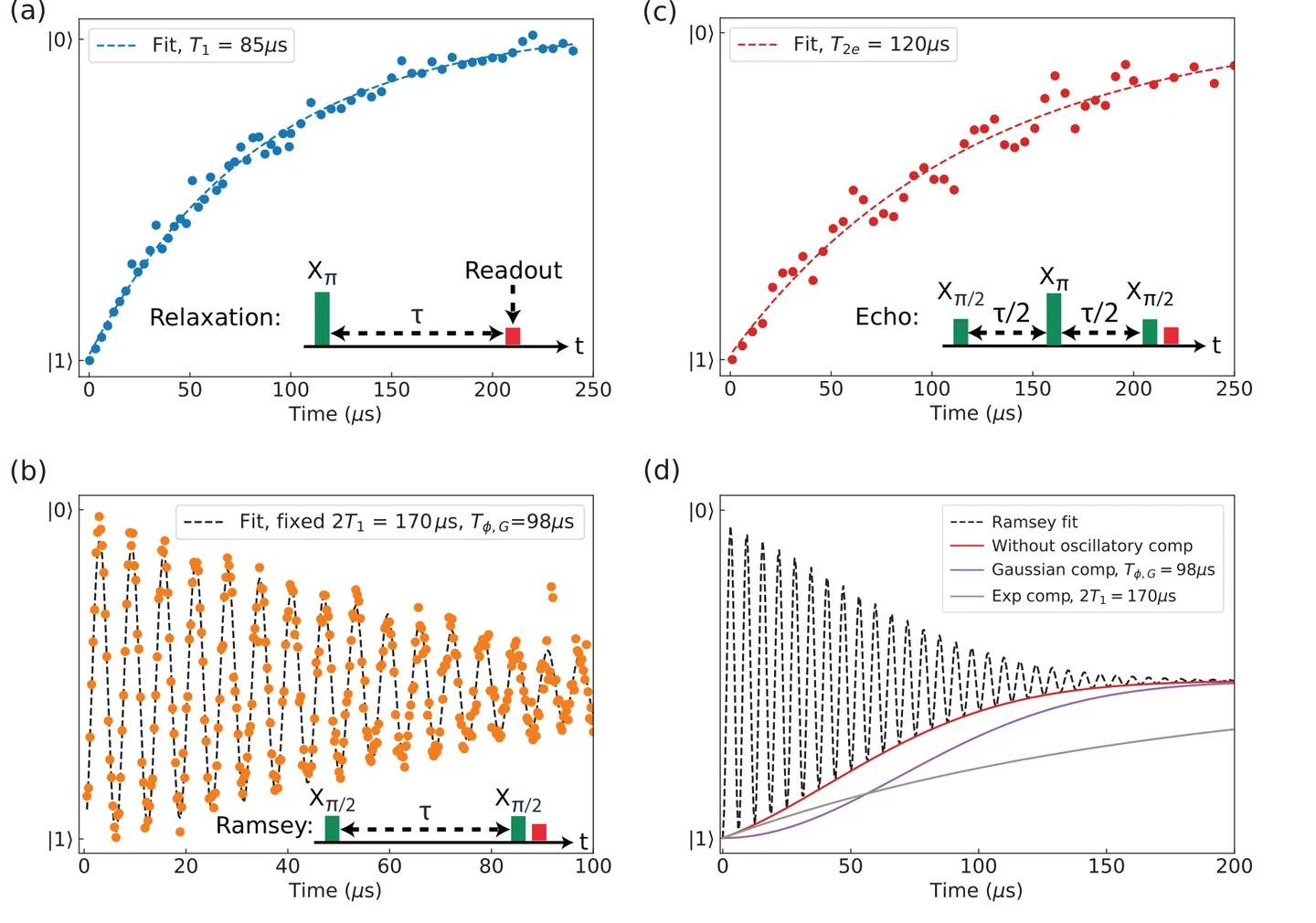
What sets T1? Only noise at the qubit’s own frequency can take its energy, because relaxation is a transition and a transition needs something to resonate with [2]. A transmon at 5 GHz sheds its energy into whatever around it can absorb at 5 GHz: defects in the oxides on the chip’s surfaces, the line that reads it out, stray unpaired electrons in the superconductor itself. Removing those absorbers is a materials problem, and the materials people have been winning. In 1999 the Cooper-pair box, the transmon’s ancestor, held its state for a few nanoseconds [6]. The transmon in the figure, published in 2019, holds it for 85 µs. In 2021 a group at Princeton replaced the niobium in the circuit with tantalum and pushed T1 past 0.3 milliseconds [7]. That is five orders of magnitude in about twenty years, with the design of the qubit changing far less than the recipe for making it.
How long it keeps phase
Energy is half the story. A qubit also carries a phase, the angle of the Bloch vector around the equator, and a computation depends on that being remembered too. To measure it we borrow from Norman Ramsey, who in 1950 found a way to measure the transition frequencies of molecules in a beam far more sharply, by hitting them with two short bursts of oscillating field separated by a long wait instead of one long burst [8]. It became the method at the heart of the atomic clock, and it earned him half of the 1989 Nobel Prize [9].
On a qubit it looks like this. A π/2 pulse puts the Bloch vector on the equator; you wait a time τ; a second π/2 pulse brings it back to the poles, and you measure. The pulses come from a generator, and the Bloch sphere we draw rotates at the generator’s frequency, so if the qubit’s frequency differs from it by δω, the vector precesses in that frame through an angle δω τ during the wait. Depending on where it has got to, the second pulse brings it up or down, and as τ is stepped the signal oscillates,
These are the Ramsey fringes in panel (b), and they hand you two numbers at once. The frequency of the fringes is the detuning δω, which pins the qubit’s frequency far more precisely than the search did: over a wait of 100 µs, an error of one kilohertz turns the vector by a tenth of a turn, which is easy to see, so a 5 GHz qubit is pinned to better than a part in a million. That is why Ramsey’s clocks work.
The envelope of the fringes gives T2*, which is 95 µs here. The fringes die because the qubit’s frequency is not constant. Every stray field that shifts it, charge moving on the surfaces or flux creeping through the circuit, makes the vector precess a little faster or slower in each run, so the runs fan out around the equator and their average washes out. The star is a warning: this number includes noise so slow that the frequency is steady within one run but different in the next, like a watch that gains a different amount each day.
Undoing the slow noise
Erwin Hahn found the cure in 1950, also for nuclear spins [10]. Put a π pulse in the middle of the wait. Think of runners on a track who each run at their own steady pace: after half the time they are spread out, but turn every one of them around and they arrive back at the start together. The π pulse is the turn-around. Any frequency error that stayed constant during the wait is cancelled; only noise that changes within the wait survives. Panel (c) shows the result: the decay stretches from 95 to 120 µs, and the improvement measures how much of the noise was slow.
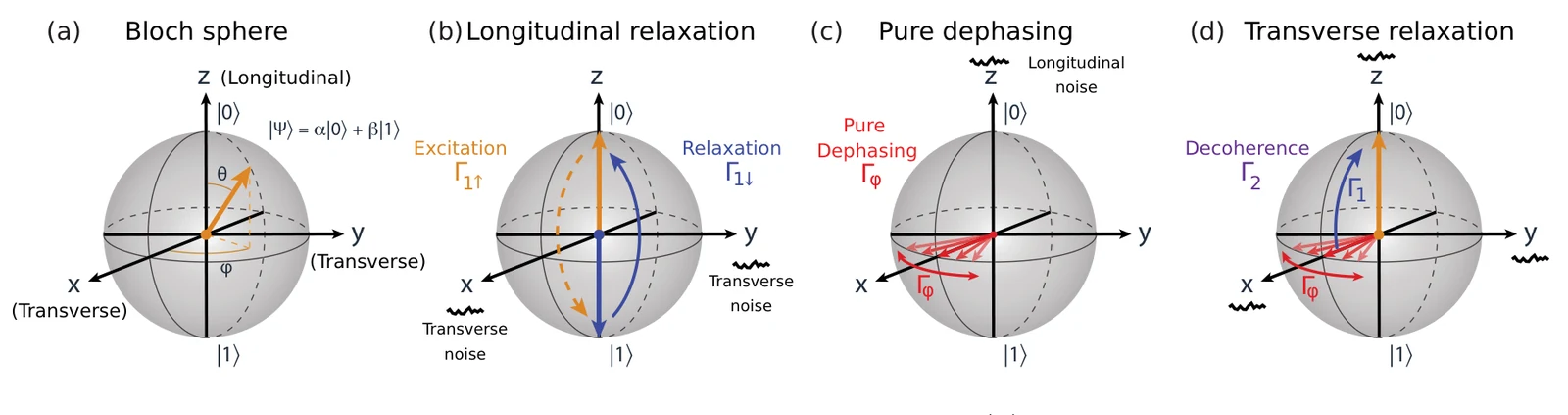
The echo cannot help for ever, because energy decay runs underneath it. A qubit that drops from 1 to 0 during the wait loses its phase along with its energy, and this contributes half a rate to the loss of coherence:
where Tφ is the pure dephasing time, the part from frequency wander alone [2]. So T2 can never exceed 2T1, here 170 µs, and the gap between the measured 120 µs and that ceiling is the dephasing the echo could not remove. Panel (d) shows one last subtlety: once the exponential from T1 is divided out of the Ramsey data, what remains decays as a Gaussian rather than an exponential, the fingerprint of the 1/f flux noise that haunts every superconducting circuit [2].
Why it is never finished
Notice the order. The π pulse needs the frequency, the Ramsey experiment needs the π/2 pulse, the T1 measurement needs the π pulse, and reading the qubit out well needs all of them, so calibration is not a list of experiments but a graph of them, each resting on the ones before. Google’s team wrote this down literally: their calibration software holds the experiments as a directed acyclic graph and treats calibrating a qubit as walking the graph, re-running a node only when its result has gone stale [11].
And they do go stale. The same group showed that the T1 of a given qubit is not a fixed number at all. It wanders unpredictably over time, because the defects on the chip that absorb its energy drift in frequency and come in and out of resonance with it [12]. A processor with a hundred qubits is therefore not calibrated once but continuously, by software walking the graph in the background. That graph is also where most of my PhD is spent.
In short
A caesium atom is calibrated by nature, once, for all caesium atoms. A transmon is calibrated by us, qubit by qubit, every day: find it, push it, time how long it holds energy, time how long it holds phase. What delights me is where the tools came from. Rabi’s oscillation was worked out for a spin in a magnetic field in 1937; Ramsey’s fringes and Hahn’s echoes were built for nuclei in 1950, and the fringes became the heart of the atomic clock. None of it was invented for quantum computing. The thing precessing in Rabi’s experiment was a single nucleus. In ours it is a few billion electrons that have agreed to behave as one, and they answer to the same formulas, fringe for fringe.
References
- Bureau International des Poids et Mesures. SI base unit: second (s). bipm.org/en/si-base-units/second.
- P. Krantz, M. Kjaergaard, F. Yan, T. P. Orlando, S. Gustavsson and W. D. Oliver. A quantum engineer's guide to superconducting qubits. Applied Physics Reviews 6, 021318 (2019), sections III.B, IV.D and V.A. doi:10.1063/1.5089550; arXiv:1904.06560.
- J. B. Hertzberg, E. J. Zhang, S. Rosenblatt, E. Magesan, J. A. Smolin, J.-B. Yau, V. P. Adiga and M. Sandberg. Laser-annealing Josephson junctions for yielding scaled-up superconducting quantum processors. npj Quantum Information 7, 129 (2021). doi:10.1038/s41534-021-00464-5.
- I. I. Rabi. Space quantization in a gyrating magnetic field. Physical Review 51, 652 (1937). doi:10.1103/PhysRev.51.652.
- I. I. Rabi, J. R. Zacharias, S. Millman and P. Kusch. A new method of measuring nuclear magnetic moment. Physical Review 53, 318 (1938). doi:10.1103/PhysRev.53.318.
- Y. Nakamura, Yu. A. Pashkin and J. S. Tsai. Coherent control of macroscopic quantum states in a single-Cooper-pair box. Nature 398, 786 (1999). doi:10.1038/19718.
- A. P. M. Place et al. New material platform for superconducting transmon qubits with coherence times exceeding 0.3 milliseconds. Nature Communications 12, 1779 (2021). doi:10.1038/s41467-021-22030-5.
- N. F. Ramsey. A molecular beam resonance method with separated oscillating fields. Physical Review 78, 695 (1950). doi:10.1103/PhysRev.78.695.
- The Royal Swedish Academy of Sciences. The Nobel Prize in Physics 1989. nobelprize.org/prizes/physics/1989.
- E. L. Hahn. Spin echoes. Physical Review 80, 580 (1950). doi:10.1103/PhysRev.80.580.
- J. Kelly, P. O'Malley, M. Neeley, H. Neven and J. M. Martinis. Physical qubit calibration on a directed acyclic graph. arXiv:1803.03226 (2018).
- P. V. Klimov et al. Fluctuations of energy-relaxation times in superconducting qubits. Physical Review Letters 121, 090502 (2018). doi:10.1103/PhysRevLett.121.090502.