


The week my ETH turned out to be an IOU
I never held much on FTX, so I thought the collapse would pass me by. Then I learned that the ETH in my Solana options vault was soETH, a token backed by FTX and Alameda. What happened this week, what a wrapped token really is, how to read its price as a recovery estimate, and the rules I am keeping.
Eleven days ago I would have said that FTX had almost nothing to do with me. I had a small amount of staked ETH on the exchange and nothing else. By Wednesday morning it was frozen, and by Friday I had learned that the “ETH” in my Solana options vault was not ETH at all, but a token whose value depended on FTX and its sister firm, Alameda Research. This is what the week looked like from a student’s wallet, and what I am changing because of it.
Eleven days
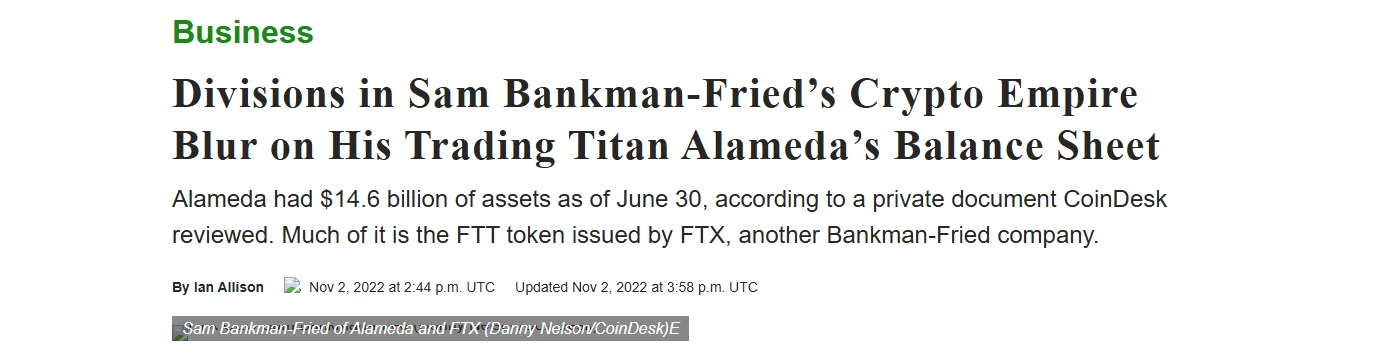
It started with a balance sheet. On 2 November, CoinDesk reported on a private document showing that Alameda, Sam Bankman-Fried’s trading firm, held $14.6 billion of assets, of which the largest single item was $3.66 billion of FTT, the token issued by his own exchange, FTX [1]. The same document listed hundreds of millions of dollars of SOL. From there the week ran very fast.
On 6 November, Binance’s chief executive said it would sell its FTT. On 8 November Binance signed a non-binding letter of intent to buy FTX, and on 9 November it walked away [2]. By the time I checked on Wednesday morning in Singapore, FTX withdrawals were frozen. SOL fell 42% to under $14 in a day, as traders worried that Alameda would have to sell and that about 55 million staked SOL were due to unlock at the end of the epoch [3]. On Friday, FTX, Alameda and about 130 affiliated companies filed for Chapter 11 bankruptcy, and Bankman-Fried resigned [4].
What was actually in my vault
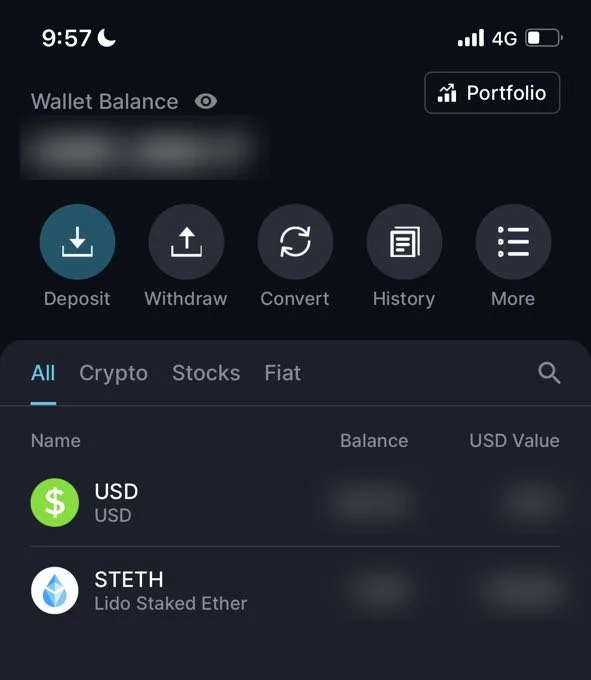
Earlier this year I put a small amount of ETH into Katana, a covered-call vault on Solana, which I wrote about in June. On Solana, ETH cannot exist natively. What a Solana app calls ETH is a wrapped token: someone holds real ETH on Ethereum and issues a token on Solana that is supposed to be redeemable for it. The version in my vault was soETH, issued through Sollet, and Sollet’s wrapped assets were custodied by FTX or Alameda [5]. For soBTC, the Sollet-wrapped bitcoin, FTX was the only place where the token could be redeemed for the real asset, and about 90% of the circulating supply sat in wallets controlled by FTX or Alameda [6].
So my exposure to FTX was not the small balance on the exchange. It was also the vault, through the token. I had checked that Katana’s contracts were sound and that the strategy made sense. I had never asked who stood behind the asset itself.
The vault added a second problem: time. Katana runs in weekly rounds. Deposits are locked while the week’s options are sold, and positions roll into the next round automatically [7]. On Wednesday, when SOL was falling by the hour, I could request a withdrawal but not receive it; it would be released when the round ended on Friday. A weekly vault is fine in a normal week. In a run, a week is a very long time.
Reading the price of an IOU
On Saturday, The Block reported what the market thought these tokens were worth [5]. Sollet-wrapped bitcoin was trading at $3,866, while bitcoin itself was at $16,819. soETH was at $1,138, against $1,255 for ETH.
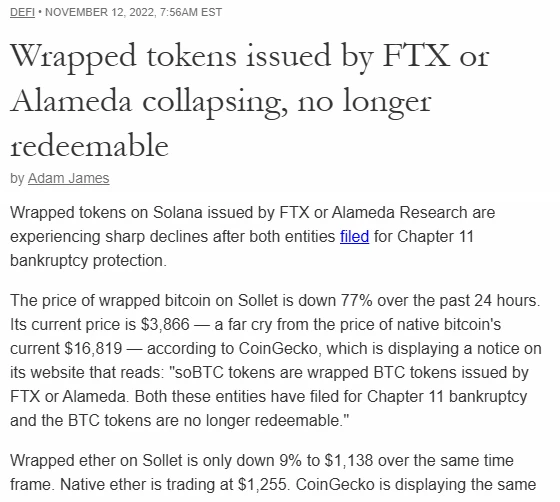
A wrapped token that can no longer be redeemed is a claim on whatever the issuer’s estate eventually pays out. Its price is therefore the market’s estimate of that recovery, R, as a fraction of the real asset:
The formula leaves out time and the cost of trading out, so it is only a rough reading. But the gap between the two is the interesting part. The market priced a soBTC holder’s recovery at less than a quarter of the bitcoin, and a soETH holder’s at nine-tenths of the ETH, for two tokens from the same bridge. My guess is that the gap reflects who held the tokens: when nearly all of soBTC sat with FTX and Alameda, there was almost nobody left to buy it, while soETH still had a market on Solana. Either way, a token’s name is a claim, not a fact.
What I did
By Friday evening my SOL was out of the vault. The soETH was waiting for the round to release it, and I plan to swap it the moment it does rather than wait for news about Sollet.
The stablecoins were next. On Wednesday, Crypto.com stopped deposits and withdrawals of USDC and USDT on Solana; its chief executive explained that FTX had been “an important bridge/venue for SOL-based stablecoins” [8]. The route I used to move money between Solana and the exchange was closed overnight. I moved my stablecoins to Polygon instead and from there into the one coin I intend to hold for the long term, staked from my own wallet.
Then I emptied the exchange. This weekend Crypto.com’s chief executive confirmed that in October the company had sent 320,000 ETH to another exchange, Gate.io, by mistake, and that Gate.io had returned it [9]. Everything I hold on Crypto.com is now gone apart from a small balance for the card. The staked ETH on FTX I have written off for now; there is nothing to do but wait for the bankruptcy.
Rules I am keeping
First, not your bridge, not your coins. “Not your keys, not your coins” is not enough. A wrapped token in my own wallet is still an IOU from whoever holds the real asset, and I will treat it as exposure to that company.
Second, the exit takes time, and the time is part of the risk. A weekly vault, an exchange withdrawal queue and a congested chain are all fine until everyone leaves at once.
Third, a run on one company spreads through its plumbing. FTX was not only an exchange. Through Alameda and Sollet it was also a bridge, a redemption desk and one of the largest holders of SOL. When it failed, things that never touched FTX directly, such as a stablecoin route and a token in an options vault, failed with it.
Fourth, hold the native asset. In a crash, the only things that kept their meaning this week were native coins in wallets I control.
The amounts involved are student-sized, and I am lucky this lesson came now rather than later. It is the second collapse this year, after Terra in May. For me it was the week I learned to ask, of every token I hold, who would have to pay me back.
References
- Ian Allison. Divisions in Sam Bankman-Fried's crypto empire blur on his trading titan Alameda's balance sheet. CoinDesk, 2 November 2022. Archived copy: 2 November 2022.
- CoinDesk. The epic collapse of Sam Bankman-Fried's FTX exchange: a crypto markets timeline. 12 November 2022. coindesk.com.
- Jocelyn Yang. Solana blockchain hit by FTX tremors as nearly $800M SOL tokens set to be unstaked. CoinDesk, 9 November 2022. coindesk.com.
- Nikhilesh De. FTX files for bankruptcy protection in US; CEO Bankman-Fried resigns. CoinDesk, 11 November 2022. coindesk.com.
- Adam James. Wrapped tokens issued by FTX or Alameda collapsing, no longer redeemable. The Block, 12 November 2022. Archived copy: 12 November 2022.
- Danny Nelson. Solana's wrapped bitcoin price craters, recovers after FTX shuts exit ramp. CoinDesk, 11 November 2022. coindesk.com.
- Sitesh Kumar Sahoo. How to Katana: the yield machine on Solana, a deep dive. Medium, 24 March 2022. insitesh.medium.com.
- Sam Kessler. Crypto.com halts Solana USDC and USDT deposits, withdrawals. CoinDesk, 9 November 2022. coindesk.com.
- Molly White. Crypto.com CEO admits company accidentally sent 320,000 ETH to another crypto exchange a few weeks prior. Web3 is Going Just Great, 12 November 2022. web3isgoinggreat.com.