


DeFi Summer from the cheap seats
This summer DeFi went from a niche to a mania: COMP, YFI, CRV and now UNI. I watched it from a student-sized wallet, where a fixed fee per transaction turns the headline yields upside down. The arithmetic of who can afford to farm, and what I'm taking from the summer.
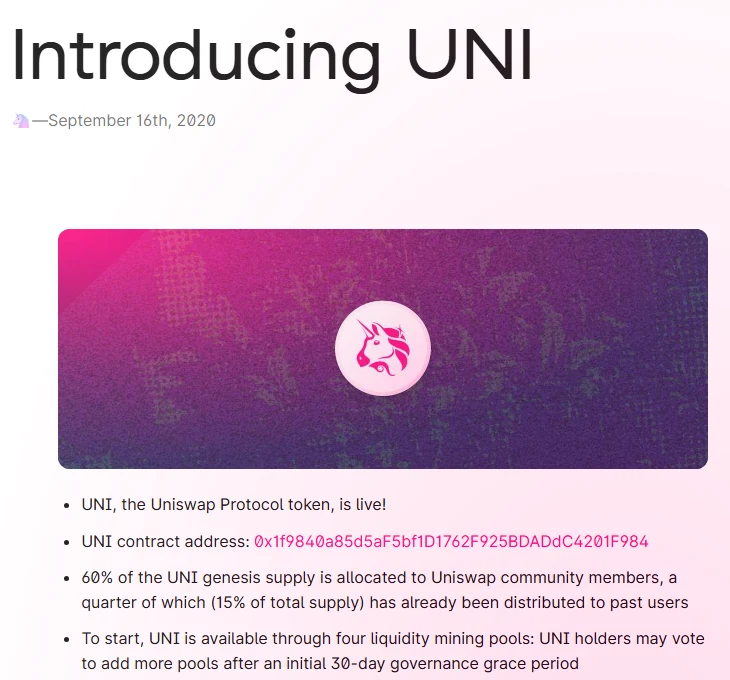
Yesterday I finally understood why Ethereum had become so expensive this week. Uniswap, the largest decentralised exchange, had launched its own token, UNI, and given it away to everyone who had ever used it. Hundreds of thousands of people were trying to claim it, sell it or farm it at once, and they were all bidding for the same blocks. That has been the pattern of the whole summer: a new token, a rush of people, and a gas price that decides who gets to take part.
I did my first swap on a decentralised exchange in March, so this is my first summer on-chain. I’ve watched it mostly from the cheap seats, and from there it looks quite different from the headlines.
Four months
It started on 15 June, when Compound began handing out its new governance token, COMP, to everyone who lent or borrowed on it: half a COMP every block, about 2,880 a day [1]. Lending and borrowing suddenly paid a second yield on top of the interest, and the press started calling it liquidity mining, or yield farming. On 17 July, yearn launched YFI with no pre-mine and no sale; the only way to get it was to provide liquidity, and its creator’s advice was “Don’t buy it. Earn it.” [2]. On 13 August, Curve launched CRV, and set aside 5% of the supply for everyone who had provided liquidity before the token existed [3]. On 9 September, SushiSwap moved more than $800 million of liquidity out of Uniswap in a single migration [4]. And on 16 September, Uniswap answered with UNI [5].
Over the same four months, the value deposited in DeFi went from under $1 billion to almost $10 billion [6].
The fee doesn’t care how much you have
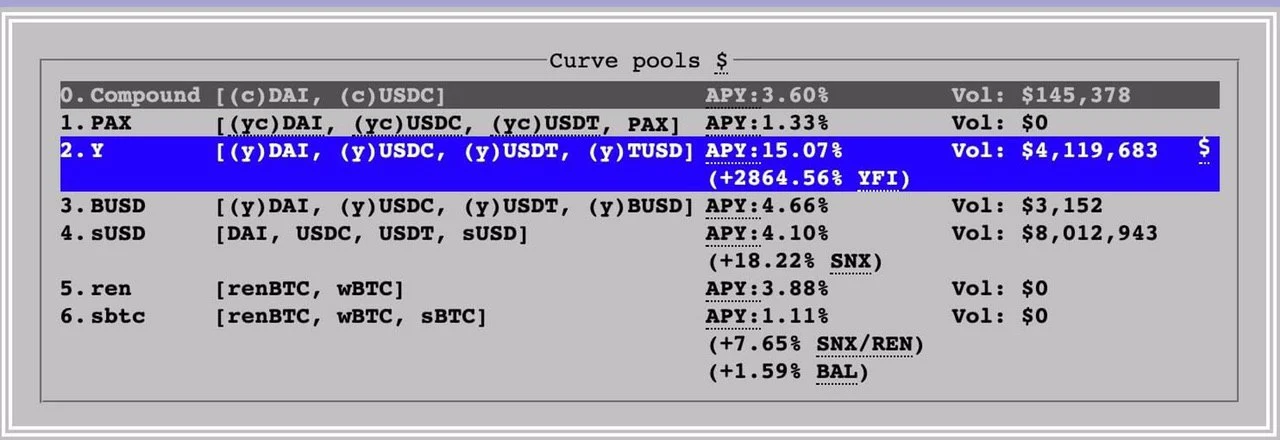
On 21 July, Curve’s own page listed its y pool at 15% a year, plus another 2,865% paid in YFI. My first reaction was that this was all for whales. Someone like me, moving a small amount in and out, would lose to the fees.
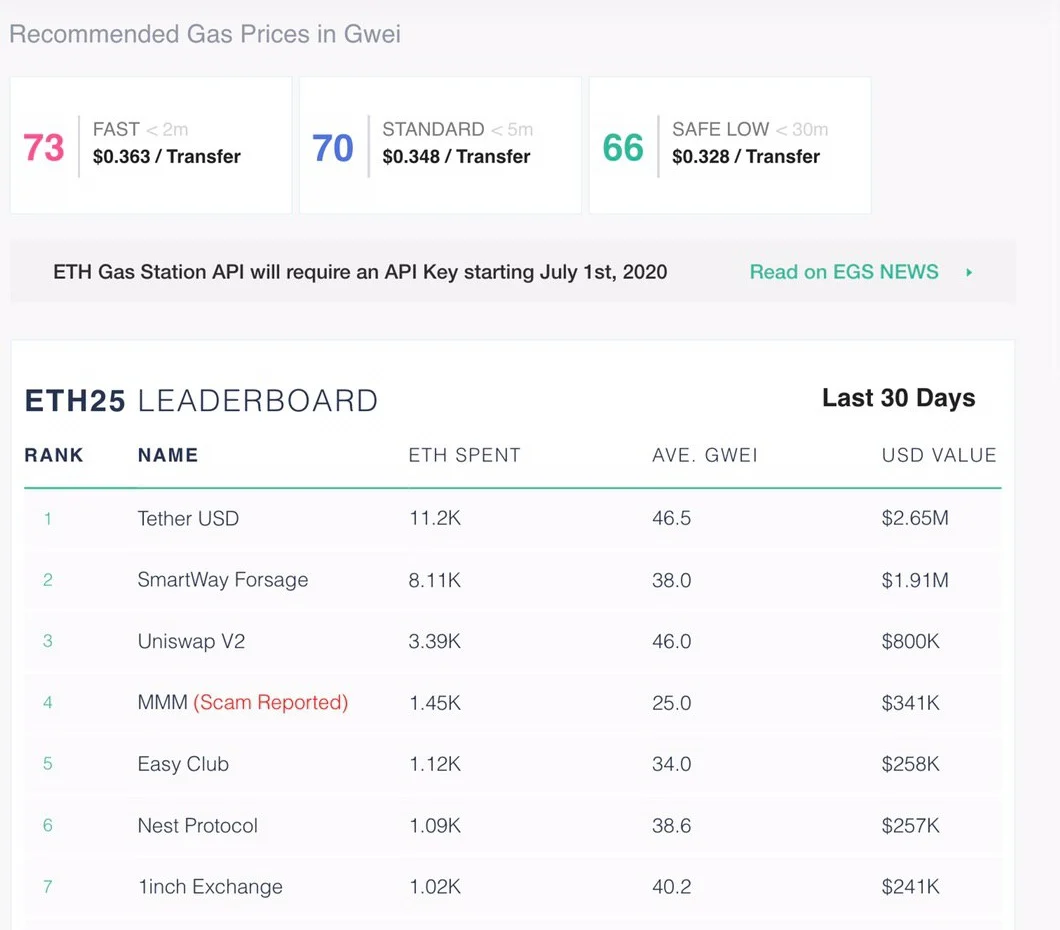
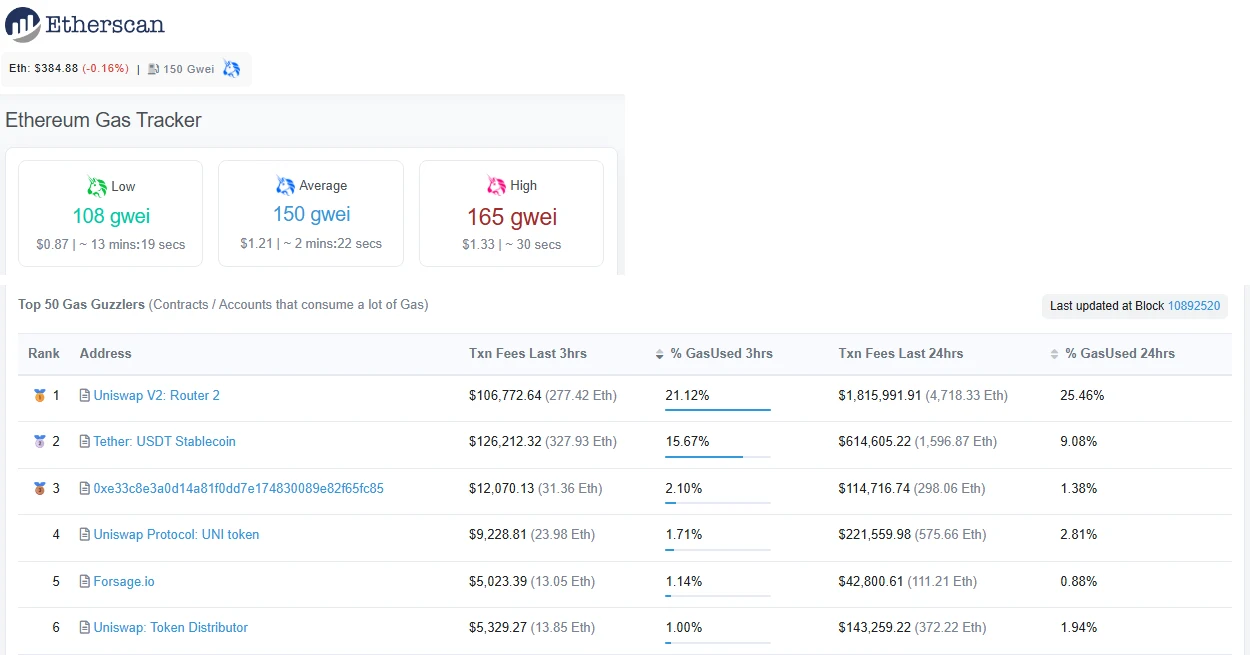
The reason is that an Ethereum transaction costs the same whatever it is moving. Depositing ten dollars into a pool uses the same gas as depositing ten million. In June and July the average Ethereum transaction cost under a dollar. In September so far it has averaged about $6, with a peak of $14 on 2 September; on 17 September, the day UNI could be claimed, the average gas price over the whole day was 538 gwei, the highest of the year [7]. And DeFi transactions are not average ones. A swap on Uniswap uses about 120,000 units of gas; a deposit into Curve’s y pool through its zap contract uses close to 900,000, and taking it out again more than a million.
and my real yield is
The fee term is divided by the size of the position. For a whale it vanishes; for a student it can swallow the yield whole. The position at which farming merely breaks even is
Here are today’s numbers. Gas is averaging about 133 gwei and ETH is $371 [7]. Going into Curve’s y pool, staking, claiming twice and coming back out adds up to around three million gas, roughly $150. Take a pool advertising 20% a year and stay for three months, so t = 0.25:
Below three thousand dollars, farming that pool loses money. With five hundred dollars, which is closer to what a student has, the yield over three months is $25 and the gas is $150: I would end the quarter a quarter poorer, a net yield of −100% a year, from a pool advertised at +20%.
The same arithmetic runs in reverse when the yield falls, which it always does. A pool’s APY is mostly the price of a new token paid out to a fixed pot of depositors; as more money arrives, each dollar gets a smaller share, and as farmers sell the token, its price drops. A yield in the thousands of percent that halves every few days rewards whoever can move in and out fastest and cheapest. That is not me.
What I did have
I wasn’t completely in the stands. I had a little DAI lent on Compound, which has been quietly earning COMP since June, and a small position in a Curve pool. When Curve launched its token in August, it gave CRV retroactively to everyone who had provided liquidity before, so a modest amount of CRV appeared in my wallet, vesting over a year. The whole allocation was 151.5 million CRV, spread over roughly 11,700 addresses, and it was extremely unequal: a typical address got a few dozen CRV, and the single largest got about a fifth of everything [3]. My share was well below the typical one. It vests a little every day, and claiming it costs more in gas than many days of vesting are worth, so I will claim it rarely.
Those were the best returns I had this summer, and I didn’t trade for any of them. They came from having used a protocol early, with small amounts, before there was any reward for doing so. Uniswap has now done the same on a much larger scale. Every address that had used Uniswap before 1 September could claim 400 UNI [5]. On the first day UNI traded at around $3; by Friday, 400 UNI were worth more than $2,000 [9]. The claim itself used about 50,000 gas, a few dollars even this week. A retroactive airdrop is the one part of DeFi Summer that runs the fee arithmetic in a small wallet’s favour: the reward doesn’t scale with what you deposited, so 400 UNI is the same gift whether you swapped ten dollars or ten million.
What I’m taking from the summer
First, fees are part of the yield, and for a small wallet they are most of it. Before entering a pool, I now work out the break-even size first and the APY second.
Second, the highest yields are the shortest-lived. They are a token being given away, and they decay as soon as people arrive. By the time a yield is famous enough for me to hear about it, it is mostly gone.
Third, being early and small is a strategy of its own. The cheapest way into DeFi this year was not to farm, but to use protocols, a little, before they had a token.
Fourth, everything traditional finance has, DeFi has too, only more intense: lending, market making, leverage, bubbles, even the September correction. Watching it happen in a few months, in public, on a chain anyone can read, is the best finance course I could have asked for. I just can’t afford the tuition yet.
References
- Compound. COMP distribution, key delegates, new markets. Compound newsletter, 18 June 2020. compound.substack.com.
- Andre Cronje. YFI. iearn.finance on Medium, 17 July 2020. Archived copy: 20 July 2020.
- Curve. LP vesting script and early-user allocations, curve-dao-contracts, 11 August 2020: vest_lp_tokens.py, early-users.json. See also Decrypt, CRV distribution: everything you need to know, 11 August 2020.
- The Block. SushiSwap initiates migration of over $800M in liquidity funds from Uniswap. 9 September 2020. theblock.co.
- Uniswap. Introducing UNI. 16 September 2020. Archived copy: 21 September 2020.
- DeFi Pulse. Total value locked in DeFi: $948.6 million on 3 June 2020 and $9.77 billion on 21 September 2020. Archived copies: 3 June, 21 September.
- Etherscan. Daily average gas price, average transaction fee and ETH price. Gas price, transaction fee, ETH price.
- Etherscan. Ethereum gas tracker, 19 September 2020. Archived copy: 19 September 2020.
- CoinDesk. Uniswap's newly launched UNI token has already doubled in price. 18 September 2020. coindesk.com.